
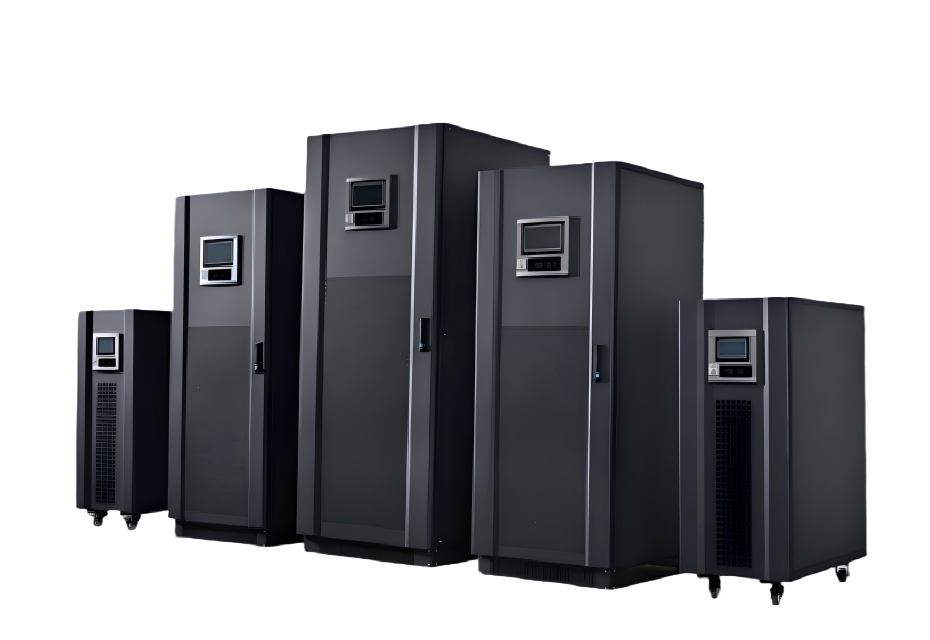
【Professional Analysis】What is a UPS (Uninterruptible Power Supply)? A Comprehensive Guide to Enterprise Power Protection
In the digital age, power stability is directly related to business operational continuity and data security. Sudden power outages or voltage fluctuations can lead to data loss, equipment damage, and even production interruptions, causing immeasurable economic losses. The Uninterruptible Power Supply (UPS) is the critical power protection device designed for this very purpose.
I. UPS: The “Security Guard” Against Power Interruptions
An Uninterruptible Power Supply System is a constant voltage and frequency power supply device primarily composed of an inverter and energy storage components. Its main function is to immediately provide clean, stable power to connected load equipment during utility power anomalies or interruptions, ensuring critical systems have sufficient time for safe shutdown or switching to backup power sources.
II. How Does a UPS Work? Three Core Protection Mechanisms
Outage Protection: When utility power completely fails, the UPS switches to battery power within milliseconds, achieving zero-interruption transition.
Voltage Regulation: Automatically adjusts input voltage to eliminate the effects of over-voltage, under-voltage, or fluctuations on equipment.
Power Purification: Filters out power surges, harmonics, and frequency drift from the grid, providing a clean power environment.
III. Analysis of Three Main UPS Types
1. Standby UPS (Offline/Standby UPS)
Working Principle: Directly passes utility power during normal operation; switches to inverter power during outage.
Transfer Time: 2-10 milliseconds.
Application Scenarios: Personal computers, office equipment, POS systems, and other non-critical devices.
Advantages: Low cost, high efficiency, compact size.
2. Line-Interactive UPS
Working Principle: Incorporates automatic voltage regulation (AVR), reducing battery usage frequency.
Transfer Time: 2-4 milliseconds.
Application Scenarios: Small to medium business servers, network equipment, medical devices.
Advantages: Strong voltage regulation capability, longer battery life.
3. Online Double-Conversion UPS
Working Principle: Utility AC is first rectified to DC, then inverted back to AC output, achieving complete isolation.
Transfer Time: Zero transfer time.
Application Scenarios: Data Center UPS, Medical UPS, financial trading systems.
Advantages: Highest level of power protection, completely pure output power.
IV. Critical Application Scenarios: Which Industries Must Deploy UPS?
Data Centers & IT Rooms: Ensure 24/7 uninterrupted operation of servers and storage equipment.
Healthcare Institutions: Provide reliable power for life-support equipment and medical imaging systems.
Industrial Environments: Protect automation production lines and PLC control systems from power disturbances.
Financial Services: Ensure continuous availability of trading systems and ATM networks.
Communication Base Stations: Maintain continuous operation of communication infrastructure.
V. How to Choose the Right UPS? Five Key Considerations
When selecting an Uninterruptible Power Supply System, comprehensively evaluate the following factors:
Power Capacity: Calculate total power requirements of all connected equipment, adding 20-30% redundancy.
Battery Runtime: Determine battery capacity and configuration based on required backup time.
Equipment Type: Critical equipment recommends Online Double-Conversion UPS; standard equipment may use Line-Interactive.
Management Features: Consider remote monitoring, automatic shutdown, network management capabilities.
Scalability: Reserve expansion space for future equipment additions.
VI. Professional Maintenance: Ensuring Continuous UPS Reliability
Even the best UPS Power Supply requires regular maintenance:
Quarterly inspection of battery status and connections.
Regular load testing.
Maintain clean environment and suitable temperature.
Monitor device alarm information.
Establish battery replacement plan (typically 3-5 years).
VII. Future Trends: Intelligence and Efficiency
Modern UPS Systems are evolving towards greater intelligence and efficiency:
Lithium-ion battery technology applications: smaller size, longer lifespan.
AI predictive maintenance: early warning of potential failures.
Cloud-based monitoring and management: centralized power management.
High-efficiency design: reduced operational costs.
Conclusion: Investing in UPS is Investing in Business Continuity
In today’s highly power-dependent business environment, Uninterruptible Power Supplies have transformed from “optional equipment” to “critical infrastructure.” Choosing the right UPS solution not only prevents data loss and equipment damage but also ensures business operational continuity, maintains brand reputation, and ultimately protects core business interests.
Our company provides comprehensive Power Protection Consultation services, covering the entire process from manufacture, solution design, to installation and maintenance. To learn about Industrial-Grade UPS Products or Data Center UPS Solutions suitable for your business needs, please contact our technical team for a personalized proposal.