
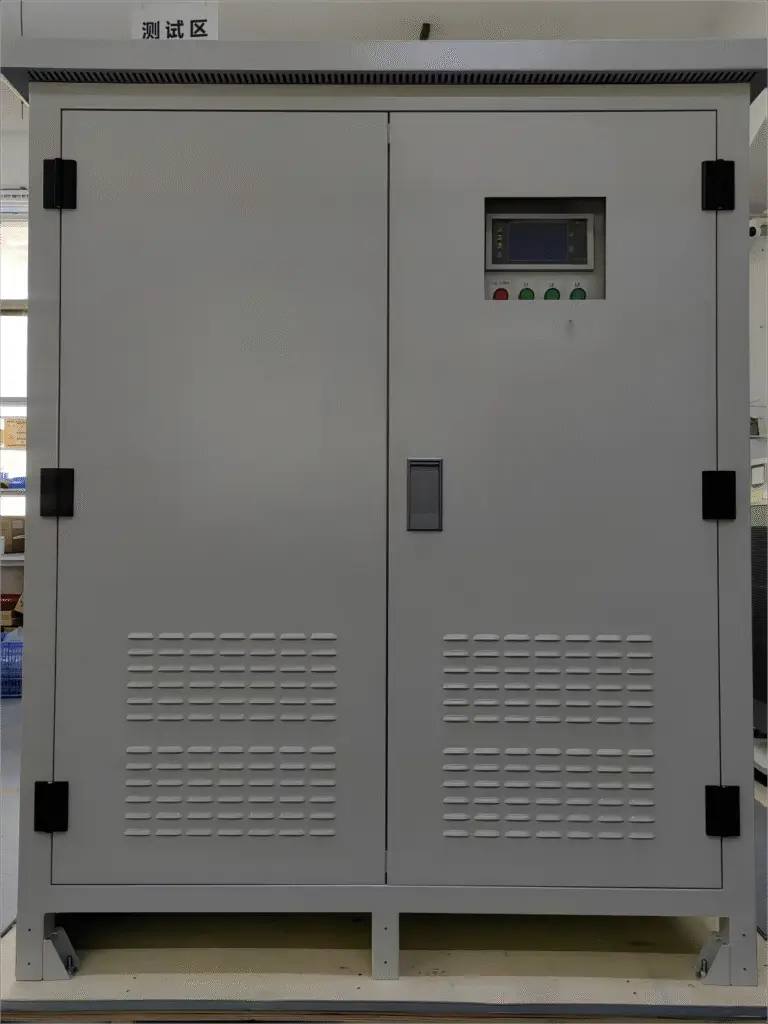
How Does a Static Voltage Stabilizer Work?
Voltage fluctuations are a common challenge in power systems, potentially leading to equipment failures or reduced efficiency. The static voltage stabilizer (Static Voltage Stabilizer, abbreviated as SVS) serves as an advanced electronic device that effectively addresses this issue. This article will focus on explaining how a static voltage stabilizer works, including its core principles, mechanisms, advantages, and differences from servo stabilizers, helping you gain a deeper understanding of this technology.
Overview of Static Voltage Stabilizer
A static voltage stabilizer is a voltage regulation device without mechanical moving parts, utilizing solid-state electronic components to stabilize input voltage. It ensures constant output voltage by quickly detecting and responding to voltage changes, suitable for scenarios with high power stability requirements, such as industrial, medical, and data centers. Unlike traditional mechanical stabilizers, static stabilizers rely on power electronics technology, such as IGBT (Insulated Gate Bipolar Transistor) and SCR (Silicon Controlled Rectifier), to achieve efficient regulation.
How Does a Static Voltage Stabilizer Work? Detailed Principle
The working principle of a static voltage stabilizer is based on an advanced electronic control system, typically involving the following steps:
- Voltage Detection: Built-in sensors or voltage sampling circuits monitor the input voltage in real-time. If the input voltage is higher or lower than the set value (such as 220V or 380V), the system immediately detects the deviation.
- Signal Processing: A microprocessor or control unit analyzes the voltage deviation and generates control signals. This step utilizes digital signal processing (DSP) technology to ensure precise calculations.
- Power Regulation: The core components are IGBT or SCR, which control the switching state through Pulse Width Modulation (PWM) technology to achieve buck (step-down) or boost (step-up) modes. PWM adjusts the duty cycle of the switch to change the output voltage. For example, in buck mode, it reduces voltage; in boost mode, it increases voltage. Additionally, a buck-boost transformer assists in the conversion to ensure stable output.
- Output Filtering and Stabilization: The regulated voltage passes through a filtering circuit to remove noise, providing a smooth output. The entire process has a response time typically within 10-20 milliseconds, much faster than mechanical types.
This mechanism requires no mechanical parts, resulting in no wear, low noise, and the ability to handle a wide range of input fluctuations (±20% to ±50%). PWM control is key, allowing high-speed switching to adjust voltage without generating heat loss.
Advantages of Static Voltage Stabilizer
After understanding the working principle, let’s look at its advantages:
- Ultra-Fast Response: Millisecond-level correction, suitable for precision equipment.
- High Reliability: No moving parts, with a lifespan of 15-20 years.
- Efficient Energy Saving: Efficiency >98%, reducing energy waste.
- Compact Design: Small size, easy to install.
- Low Maintenance: Electronic design, fewer failures.
These features make it superior to traditional stabilizers in modern applications.
Static Voltage Stabilizer vs Servo Voltage Stabilizer
To better understand the operation of static stabilizers, let’s compare them with servo stabilizers (Servo Voltage Stabilizer):
| Aspect | Static Voltage Stabilizer | Servo Voltage Stabilizer |
|---|---|---|
| Working Mechanism | Electronic switches (IGBT/PWM) | Mechanical servo motor and transformer |
| Response Speed | 10-20ms | Seconds |
| Maintenance Needs | Low, no wear | High, with mechanical parts |
| Efficiency | High (>98%) | Medium (about 90%) |
| Applicable Scenarios | High-precision, sensitive applications | General loads |
The electronic mechanism of static stabilizers makes them more suitable for fast-fluctuating environments.
Application Scenarios of Static Voltage Stabilizer
The working principle of static voltage stabilizers makes them applicable in various fields:
- Industrial Sector: Protecting CNC machines and automated production lines.
- Medical Equipment: Stabilizing power for X-ray machines and MRIs.
- Data Centers: Ensuring uninterrupted server operation.
- Telecommunication Systems: Maintaining base station voltage stability.
In areas with unstable grids, this equipment is particularly practical.
Conclusion
A static voltage stabilizer achieves efficient voltage stabilization through electronic detection, PWM regulation, and buck-boost mechanisms. If you need more detailed technical specifications or selection advice, contact our expert sales team.