
- Input Phase : 3L+N+G
- Input Voltage : 380/400/415VAC or Customized
- Input Frequency Range : 50/60Hz±5Hz Automatic Discrimination
- Output Phase : 3L+N+G
- Output Voltage : 380/400/415VAC or Customized
- Power Factor : 0.8/0.9
- Conversion time : 0 ms
- Battery Voltage : 480VDC
Best suited for
- ● Banking, Financial and Insurance
- ● Data Center/Colocation/Hosting
- ● Education
- ● Government
- ● Healthcare
- ● Manufacturing
- ● Telecom
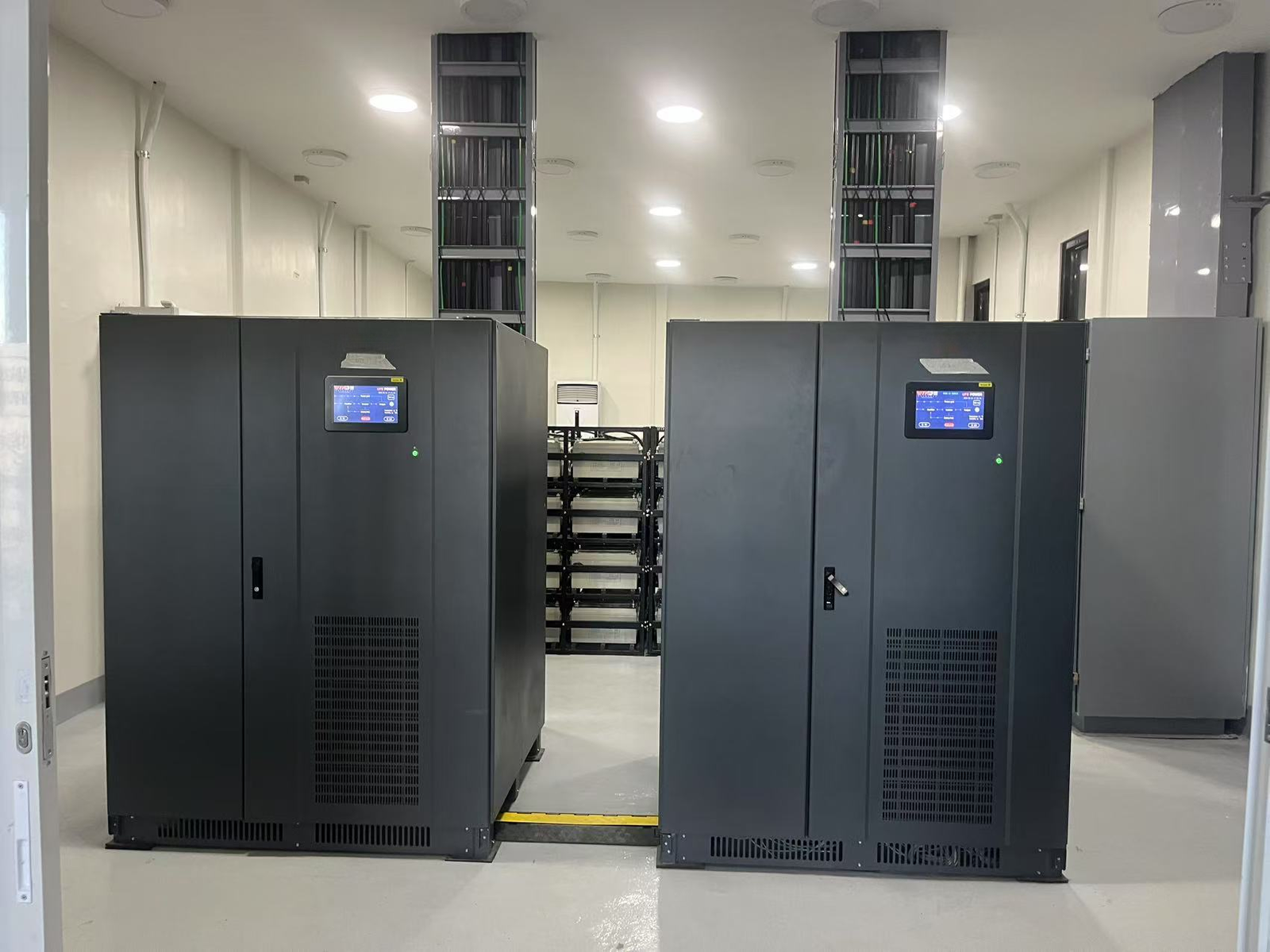
Key Benefits of Parallel UPS Schemes for Manufacturing Redundancy
- Research suggests parallel UPS systems significantly enhance reliability in manufacturing by providing seamless failover, though implementation requires careful configuration to balance cost and performance.
- They seem likely to reduce downtime risks for critical loads like machinery and control systems, with evidence leaning toward N+1 setups as a practical standard for industrial environments.
- Benefits include scalability and maintenance flexibility, but potential challenges like synchronization issues highlight the need for expert deployment to avoid complications.
Solution Overview
Our parallel UPS redundancy solutions are tailored for the manufacturing sector, where uninterrupted power is essential to prevent production halts and equipment damage. By connecting multiple UPS units—such as in N+1 or 2+1 configurations—the system ensures that if one unit fails, others seamlessly take over, maintaining clean power to motors, PLCs, and sensitive instrumentation.
Why Choose Parallel Redundancy?
- Enhanced Reliability: Distributes load across units, eliminating single points of failure and supporting 99.999%+ availability.
- Cost-Effective Scalability: Easily add modules as production grows, optimizing energy use without overbuilding.
- Maintenance Without Downtime: Isolate units for service while the system continues operating, ideal for 24/7 factories.
Explore our customizable options or contact us for a consultation to safeguard your operations.
Comprehensive Guide to Parallel UPS Redundancy Solutions in Manufacturing
Manufacturing operations rely on robust power infrastructure to sustain continuous production, protect sensitive equipment, and minimize financial losses from downtime. Parallel UPS schemes, where multiple uninterruptible power supply (UPS) units are connected to form a unified system, offer a proven approach to achieving high redundancy. This guide explores the technical principles, advantages, comparisons with other configurations, application scenarios, and implementation recommendations, drawing from industry insights to help manufacturers optimize their power strategies.
Technical Principles and Core Components
Parallel UPS systems electrically and mechanically link two or more UPS modules to deliver a single output, either for increased capacity or redundancy. Key configurations include:
- N+1 Redundancy: Incorporates at least one extra module beyond the required load (e.g., three 400 kVA modules for an 800 kVA demand). If one fails, the remaining units assume the full load without interruption.
- 2+1 Mode: Three units share the load equally (each at about 2/3 capacity normally). Upon failure, the faulty unit exits, and the two others continue seamlessly, with load increasing per unit but no downtime.
- Core Elements: Include rectifiers, inverters, batteries (often lithium-ion for extended life and wide temperature tolerance), static bypass switches, and peer-to-peer control for synchronization without external wiring. Technologies like Eaton’s Hot Sync enable autonomous load balancing and fault isolation in microseconds.
These setups ensure conditioned power, handling impulsive loads from motors and isolating faults to prevent system-wide crashes, making them suitable for harsh manufacturing environments with dust, humidity, or temperature extremes.
Advantage Analysis
Parallel redundant UPS systems provide multiple benefits tailored to manufacturing needs:
- Fault Isolation and High Availability: Eliminates single points of failure; for instance, in (1+1) setups, mean time between failures (MTBF) reaches 1,250,000 hours, achieving up to six nines (99.9999%) availability with quick mean time to repair (MTTR) of 0.5 hours in modular designs.
- Load Sharing and Efficiency: Units operate at optimal levels (e.g., 30-80% load for flat efficiency curves), reducing energy waste and extending battery life, especially with lithium-ion options lasting 10 years at 25°C.
- Maintenance Flexibility: One unit can be serviced or replaced without interrupting power, avoiding bypass mode risks like poor power quality.
- Scalability for Growth: Add modules to match expanding production demands, such as from 10kVA to 20kVA, without system overhaul.
- Robustness in Industrial Settings: Handles high-impact loads from execution equipment (e.g., motors) and protects control systems (e.g., PLCs) from voltage fluctuations, harmonics, and pulses.
Potential drawbacks include higher initial costs and the need for identical units, but these are offset by reduced total cost of ownership (TCO) through minimized downtime.
Comparison with Other UPS Configurations
To highlight the value of parallel redundancy, the following table compares it with standalone and other setups, focusing on manufacturing applications:
| Aspect | Parallel Redundant (N+1/2+1) | Standalone UPS | Dual (N+N) Redundancy |
|---|---|---|---|
| Reliability (MTBF) | High (e.g., 1,250,000 hours for 1+1) | Lower (20,000-125,000 hours) | Very High (similar to parallel but isolated) |
| Availability | 99.999%+ with low MTTR (0.5-6 hours) | 99.99% (dependent on bypass) | 99.9999% (fully isolated systems) |
| Scalability | Excellent (add modules easily) | Limited (requires full replacement) | Good (independent units) |
| Maintenance | No downtime (isolate faulty unit) | Requires bypass, risks interruption | Flexible but higher cost |
| Efficiency | Optimized load sharing, high at partial loads | Variable, often inefficient at low loads | High but potential over-redundancy |
| Cost | Moderate initial, low TCO | Low initial, high downtime costs | High initial, balanced TCO |
| Industrial Suitability | Ideal for factories (handles harsh conditions) | Basic protection, unsuitable for critical loads | Best for ultra-critical but complex |
Parallel systems excel in balancing reliability and cost for manufacturing, outperforming standalone in fault tolerance while being more efficient than fully isolated dual setups.
Application Scenarios and Solution Implementation
In manufacturing, parallel UPS redundancy is deployed for:
- Single-Point Protection: For measurement and control equipment in chemical or semiconductor plants, using 2+1 modes to prevent defective products from power glitches.
- High-Load Environments: In steel or food processing factories, N+1 configurations with lithium-ion batteries handle variable temperatures (0-55°C) and provide long backup without space constraints.
- Mission-Critical Systems: For process computers and instrumentation, dual parallel setups ensure continuous operation even during dual failures by switching to bypass.
- Real-World Cases: In university or industrial sites, two 400 kVA units in N+1 parallel maintain power for critical loads; global installations like Eaton’s demonstrate uptime in defense and manufacturing.
Get a customized power solution