
- Input Phase : 3L+N+G
- Input Voltage : 380/400/415VAC or Customized
- Input Frequency Range : 50/60Hz±5Hz Automatic Discrimination
- Output Phase : 3L+N+G
- Output Voltage : 380/400/415VAC or Customized
- Power Factor : 0.8/0.9
- Conversion time : 0 ms
- Battery Voltage : 480VDC
Best suited for
- ● Banking, Financial and Insurance
- ● Data Center/Colocation/Hosting
- ● Education
- ● Government
- ● Healthcare
- ● Manufacturing
- ● Telecom
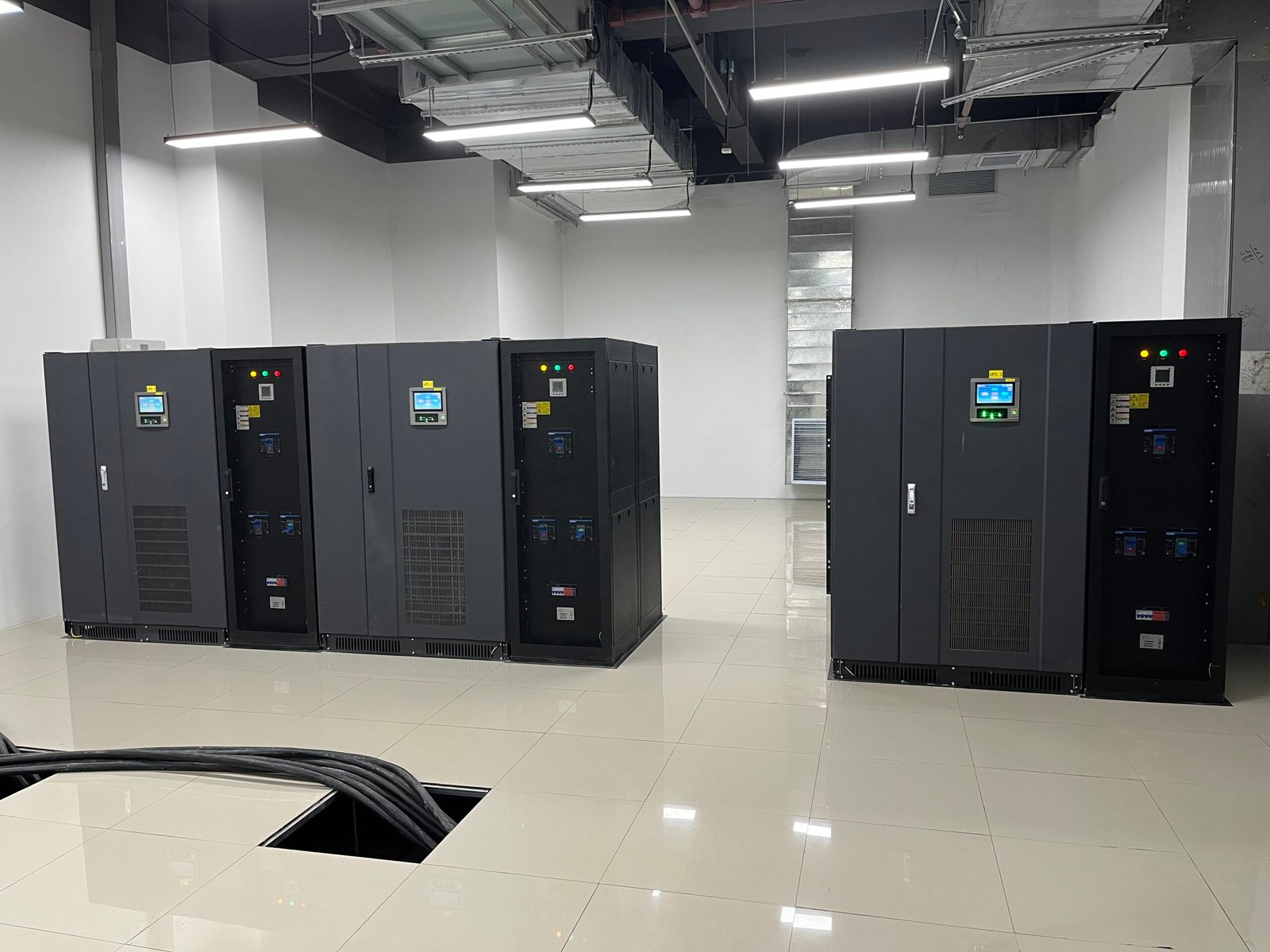
Key Benefits of Transformer-Based UPS for Data Centers
- Research suggests transformer-based UPS systems offer strong reliability through built-in isolation, making them suitable for critical environments like data centers where downtime could be costly.
- They provide effective protection against power disturbances, though transformerless alternatives may edge out in efficiency for smaller setups.
- Evidence leans toward lower total ownership costs in large-scale applications due to reduced need for external components, but initial investments can be higher.
- While debates exist on efficiency versus robustness, transformer-based designs seem likely to excel in high-load scenarios with industrial elements.
Solution Overview
Our transformer-based UPS solutions are designed to ensure uninterrupted power for modern data centers. Utilizing double-conversion topology with isolation transformers, these systems separate input and output power, delivering clean and stable electricity. Ideal for scales from 200kW to 5MW, they support single or dual mains configurations, helping minimize downtime and operational risks.
Why Choose Our Solution?
- Reliable Protection: Integrated galvanic isolation guards against noise, harmonics, and grounding issues, safeguarding servers and storage equipment.
- Scalable Efficiency: Compatible with medium-voltage systems for rapid deployment and sustainable energy practices.
- Cost-Effective: Higher upfront costs are offset by optimized heat management and reduced maintenance, leading to lower overall expenses.
For more details, explore our product pages or contact our sales team for customized consultations.
Comprehensive Guide to Transformer-Based UPS Solutions in Data Centers
Data centers serve as the backbone of the digital economy, demanding exceptional reliability and continuity in power systems. Uninterruptible Power Supply (UPS) systems are essential for maintaining operations during grid failures, voltage fluctuations, or transient interruptions. Among these, transformer-based UPS stands out for its unique isolation and protection features, making it a preferred choice for many large-scale data centers. This guide explores the technical principles, advantages, comparisons with transformerless UPS, application scenarios, and implementation recommendations, providing data center operators with a thorough reference grounded in industry insights.
Technical Principles and Core Components
Transformer-based UPS employs an online double-conversion (AC-DC-AC) architecture, with the isolation transformer as its core element. This transformer achieves galvanic isolation, completely separating the input power from the output load. Key components include:
- Input Transformer: Positioned before the rectifier, it handles voltage matching and isolates poor grid neutrals, suppressing harmonic currents and grounding faults.
- Output Transformer: Reestablishes a TN-S grounding system (independent neutral grounding), ensuring the output neutral is disconnected from the input to prevent equipment damage.
- Additional Elements: SCR rectifiers (6-pulse or 12-pulse), IGBT-PWM inverters, battery packs, and static bypass switches. Transformer placement is flexible, allowing external positioning to optimize space and thermal management.
This design continuously delivers clean power in normal mode, with efficiency losses primarily in bypass mode (around 2-3%). In data centers, it maintains a flat efficiency curve (92-96%) from low to full loads, particularly beneficial in emerging markets or regions with unstable grids.
Advantage Analysis
In data center applications, transformer-based UPS demonstrates several key advantages:
- Fault Isolation and High Availability: The transformer prevents faults from migrating from the rectifier or bypass to the load, offering higher short circuit currents (especially phase-neutral) and dynamic response. Compared to transformerless designs, it reduces the need for external isolation, boosting system availability to over 99.999% for mission-critical tasks.
- Grounding and Noise Suppression: It isolates faulty neutrals, preventing circulating currents and ground loops, and is compatible with high-resistance grounding (HRG) systems. This is crucial for IT equipment, minimizing downtime from grounding issues, especially in industrial loads or long cable setups.
- Load Compatibility: Well-suited for high-tax loads, providing voltage step-down and power conversion, supporting dual input sources without additional transformers, which lowers initial investments and total cost of ownership (TCO).
- Efficiency and Sustainability: Modern optimizations yield 94-96% efficiency at 30-80% loads, slightly below transformerless but achieving overall savings through reduced heat losses and material use. This aligns with green data center standards, such as Uptime Institute certifications.
- Robustness and Back-Feed Protection: Handles motor loads’ back-feed without interruption, enhancing dynamic stability.
Potential drawbacks include larger size, heavier weight, and leading power factors at light loads, which may require oversized generators. However, these are often mitigated through modular designs in large data centers.
Comparison with Transformerless UPS
The UPS market for data centers features both transformer-based and transformerless designs, each with distinct focuses. The following table summarizes key differences, emphasizing data center applications:
| Aspect | Transformer-Based UPS | Transformerless UPS |
|---|---|---|
| Design Features | Integrated isolation transformer, SCR rectifier, lower component count | IGBT PWM rectifier/inverter, modular, no internal transformer |
| Efficiency | 92-96%, flat curve (30-80% load) | 96%+, better at 20% load |
| Size/Weight | Larger/heavier (e.g., 500kVA: 2.2-2.6 tons, 1.8-2.0 m²) | Smaller/lighter (e.g., 500kVA: 1 ton, 1.5-1.6 m²) |
| Reliability | High MTBF, built-in isolation, suited for >200kW | Similar availability, but more components, needs external isolation |
| Isolation Protection | Built-in galvanic isolation, defends against DC faults and grounding | Requires external transformer, potential efficiency loss (2-3%) |
| Dynamic Response | Good, but unbalanced loads may affect output | Ideal, independent phase control, no unbalanced load impact |
| Applicable Scenarios | Large critical apps, long cables, high loads | Small scalable centers, efficiency priority |
| Cost | Higher initial, but lower TCO (fewer external components) | Lower initial, but external transformers add costs |
| Input Power Factor | Lower at partial loads | 0.99-0.97, stable across loads |
| Harmonic Distortion (THDi) | 3-4% (IGBT); higher (pulse-type) | 3-4% |
| Battery Ripple | 0.2% (with charger) | 0.20% |
| Availability | Highest, simplifies fault current control | Reasonable, but relies on external components |
As shown, transformer-based UPS holds advantages in large data centers (e.g., cloud services) with built-in protection and higher availability. Transformerless UPS suits space-constrained or efficiency-focused facilities but may offset benefits with added external transformers, leading to reduced efficiency and increased TCO. Common misconceptions include assuming transformerless is inherently more reliable; in fact, they can be weaker in fault isolation without extras.
Application Scenarios and Solution Implementation
Transformer-based UPS can be configured flexibly in data centers:
- Single Mains Mode: Ideal for unstable grids, with input transformers protecting against ±20% fluctuations and output transformers placed near loads for TN-S grounding. For example, in emerging markets handling voltage instability.
- Dual Mains Mode: Isolates neutrals, compatible with RCDs, preventing circulating currents. Typical architecture: Utility grid → Medium-voltage switchgear → Transformer → UPS → PDU → Server racks.
- Medium-Voltage UPS Integration: Systems like ABB PCS120 MV UPS deliver megawatt-level protection with intelligent monitoring and remote operations for fault prediction. (Note: While the source focuses on transformer-free, principles apply; see cross-references.)
- Prefabricated Modules: Integrates transformers, UPS, and low-voltage distribution for quick deployment. Vendors like Vertiv offer such solutions, reducing installation time.
- Real-World Cases: In large AI data centers, combined with HVDC systems for 240Vdc or 360Vdc outputs, ensuring stability for high-density loads. In markets like China, suppliers emphasize transformers in rectifiers and inverters for green transitions.
Implementation Recommendations and Future Trends
When deploying:
- Selection: Prioritize for loads >200kW, assessing grid quality and expansion needs.
- Optimization: Use external transformers to minimize internal losses; integrate AI monitoring for predictive maintenance.
- Addressing Challenges: For efficiency debates, employ multi-level topologies; in UPS vs. solid-state transformer (SST) discussions, traditional designs dominate, but SSTs may emerge in high-value markets.
Looking ahead, as data center power densities rise, medium-voltage and prefabricated transformer-based UPS will become more prevalent, enhanced by tools like ABB Ability™ for improved efficiency and reliability. Overall, this solution balances reliability and cost, forming a solid foundation for sustainable data center development.
Key Citations:
- The MVP of critical applications? Transformer-based UPS
- The Role of Isolation Transformers in Data Center UPS Systems
- Transformer based UPS VS transformerless UPS
- Application of Transformer-based VS transformer-less UPS systems
- Comparing Transformer-free to Transformer-based UPS Designs
- Transformer based UPS VS transformerless UPS - EverExceed
- Data Center UPS Systems - Vertiv
Get a customized power solution