
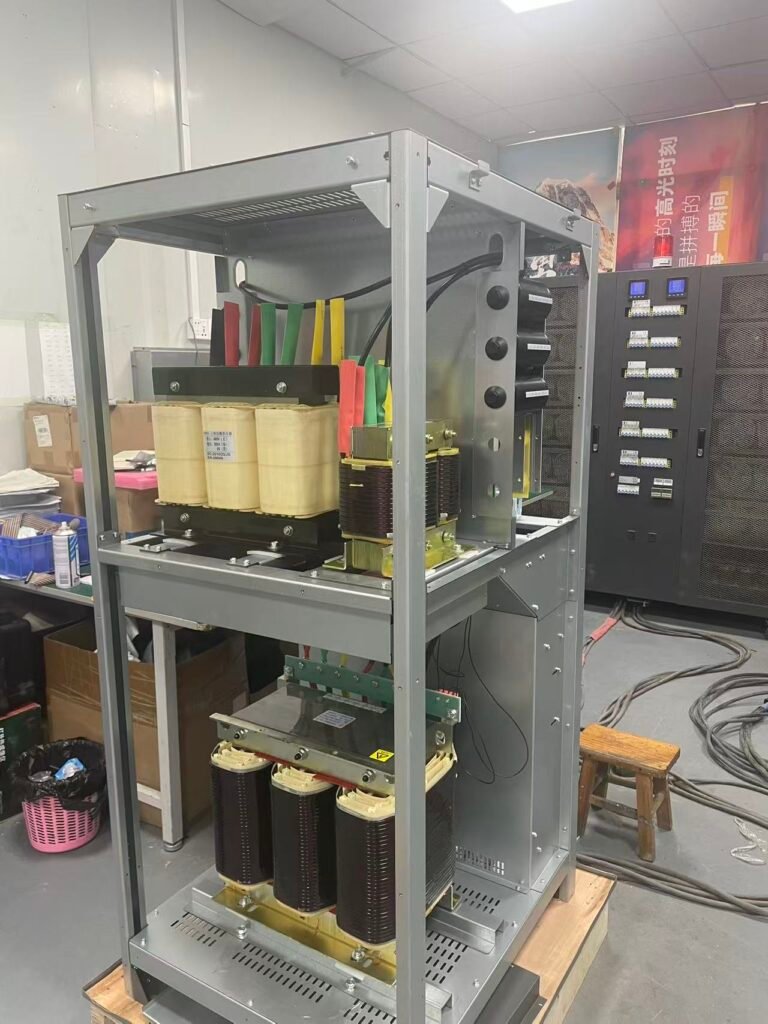
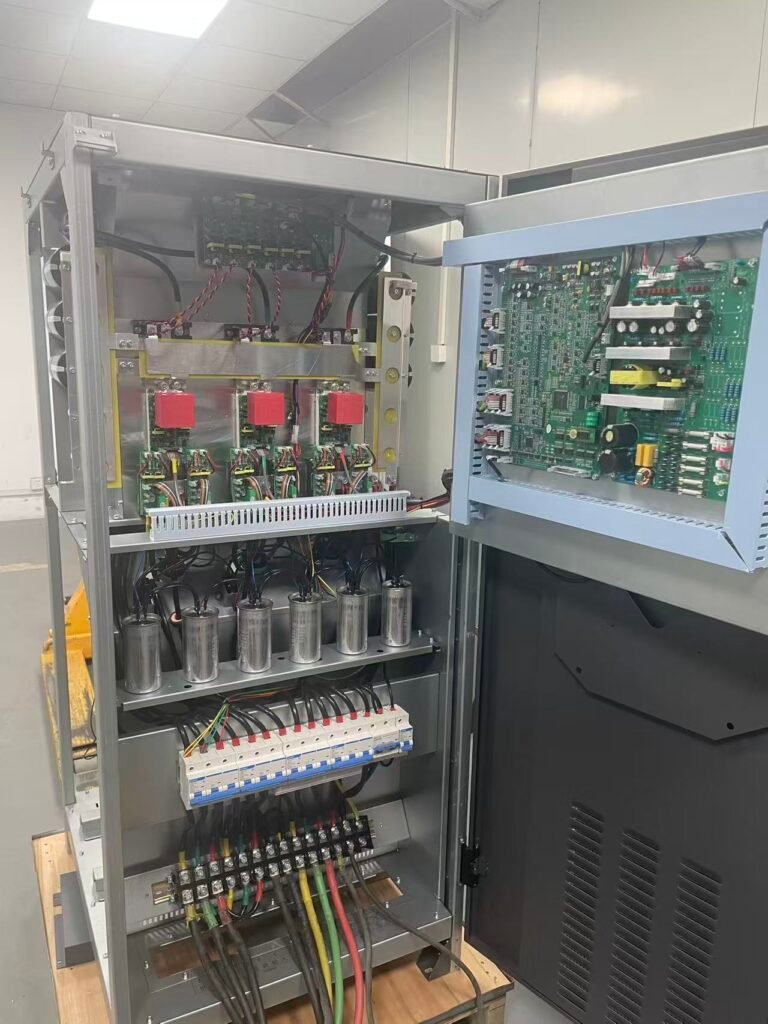
Isolation Transformer UPS: Enhancing Power Reliability with Electrical Isolation
In today’s power-dependent world, uninterruptible power supplies (UPS) are essential for safeguarding critical operations in data centers, industrial settings, and healthcare facilities. Isolation Transformer UPS, a type of transformer-based system, excels in providing superior electrical isolation and protection against power disturbances. To our transformer-based UPS product. This article explores the fundamentals, working principles, advantages, disadvantages, comparisons with transformerless UPS, and key applications of Isolation Transformer UPS to guide your power protection decisions.
What is Isolation Transformer UPS?
Isolation Transformer UPS integrates an isolation transformer within the UPS architecture to electrically separate the input power source from the output load. An isolation transformer is a specialized device that transfers electrical power between circuits while preventing direct electrical connection, thus blocking noise, surges, and ground loops. To Wikipedia on isolation transformers for detailed basics. In UPS systems, this transformer is often placed at the input or output stage, ensuring clean power delivery and enhanced safety. This design is particularly valuable in environments prone to electrical interference, offering a robust barrier that standard UPS might lack.
Unlike non-isolated systems, Isolation Transformer UPS prioritizes galvanic isolation, which protects sensitive equipment from voltage spikes and harmonic distortions without compromising power continuity.
Working Principle of Isolation Transformer UPS
Isolation Transformer UPS typically operates in an online or double-conversion mode, ensuring constant power conditioning. The core workflow includes:
- Input Processing: Incoming AC power passes through the isolation transformer, which filters out noise and provides galvanic separation before rectification to DC.
- Rectification and Battery Charging: The filtered power is converted to DC to charge batteries and feed the inverter.
- Inversion: DC is inverted back to stable AC output, isolated from input disturbances.
- Bypass and Backup: In case of faults or outages, the system switches seamlessly to battery power, maintaining isolation throughout.
This setup delivers zero-transfer-time protection and pure sine wave output, ideal for loads sensitive to power quality. To IEEE standards on UPS isolation techniques for technical specifications.
Advantages of Isolation Transformer UPS
Isolation Transformer UPS offers several key benefits:
- Superior Electrical Isolation: Effectively blocks noise, surges, and ground faults, providing better protection than non-isolated designs.
- High Reliability and Robustness: Excels in handling overloads and impacts, with fewer failure points in harsh environments. To customer testimonials on UPS reliability.
- Enhanced Power Quality: Delivers clean, stable output, reducing equipment downtime in critical applications.
- Scalability for High Capacities: Simplifies fault isolation and supports large-scale deployments. To Schneider Electric’s resources on data center UPS for real-world examples.
These features make it a go-to solution for demanding power needs.
Disadvantages of Isolation Transformer UPS
While powerful, Isolation Transformer UPS has some trade-offs:
- Increased Size and Weight: The transformer adds bulk, making installation challenging in compact spaces.
- Lower Efficiency: Typically 90-95% efficient, leading to higher energy consumption compared to alternatives.
- Higher Costs: More expensive to manufacture, purchase, and maintain due to the transformer’s complexity.
- Heat Dissipation: Generates more heat, necessitating advanced cooling systems.
These limitations may favor other designs in cost-sensitive or space-limited scenarios.
Comparison with Transformerless UPS
Transformerless UPS eliminates the transformer for a more compact design, relying on electronic components for power conversion. Here’s a side-by-side comparison:
| Aspect | Isolation Transformer UPS | Transformerless UPS |
|---|---|---|
| Isolation | Excellent galvanic isolation | Limited, relies on electronics |
| Reliability | High, robust for industrial use | Good, but more vulnerable to surges |
| Efficiency | Lower (90-95%) | Higher (up to 98%) |
| Size/Weight | Larger and heavier | Smaller and lighter |
| Cost | Higher initial and operational | Lower |
| Applications | Critical, noise-prone environments | General, efficiency-focused settings |
In summary, Isolation Transformer UPS prioritizes protection and durability, while transformerless systems emphasize efficiency and compactness. To our comprehensive UPS selection guide.
Application Scenarios for Isolation Transformer UPS
Isolation Transformer UPS is ideal for scenarios demanding top-tier protection:
- Data Centers: Prevents data loss by isolating servers from grid disturbances. To our data center power solutions page.
- Industrial Operations: Shields machinery from electrical noise in manufacturing plants.
- Healthcare Facilities: Ensures stable power for sensitive medical equipment like MRI machines.
- Telecommunications: Provides secure isolation in high-interference networks.
- High-Load Environments: Handles inductive loads and surges effectively. To Eaton’s case studies on industrial UPS applications.
Its isolation capabilities shine in these high-stakes areas.
Conclusion
Isolation Transformer UPS stands as a cornerstone for reliable power protection, offering unmatched isolation against electrical threats. Though it may lag in efficiency and size compared to transformerless options, its robustness makes it indispensable for critical infrastructure. With growing reliance on stable power, choosing Isolation Transformer UPS aligns with needs for durability and safety. Consult experts to tailor it to your setup. To our contact page for free consultations.